Cancer Expert Search

Cancer ExpertCancer Expert: Search
Enter your question and submit. Use a complete English sentence for better results.
Cancer Expert, © 2012-2013, ctSearch - Context Search Engine.
Showing posts with label stress. Show all posts

Tuesday, August 5, 2014

Be Compassionate for Life if you want to be TRULY Productive!

GREED is NOT GOOD!. Giftalism - Focus on building communities instead of Commodities. Build an Ecosystem for the GOOD! Generosity is Generative. It creates new value! Stop blind consumption and start GIVING without expecting RETURNS! https://www.youtube.com/watch?v=p_QLGvp_stI

Be Compassionate for Life if you want to be TRULY Productive!

GREED is NOT GOOD!. Giftalism - Focus on building communities instead of Commodities. Build an Ecosystem for the GOOD! Generosity is Generative. It creates new value! Stop blind consumption and start GIVING without expecting RETURNS! https://www.youtube.com/watch?v=p_QLGvp_stI

Thursday, July 10, 2014

India saw 7 bankruptcy suicides a day last year

Wed Jul 9, 2014 5:22 am (PDT) . Posted by:

Business Standard
http://www.business-standard.com/article/current-affairs/india-saw-7-bankruptcy-suicides-a-day-last-year-114070201025_1.html

Sachin P Mampatta - Mumbai July 3, 2014 Last Updated at 00:49 IST

India saw 7 bankruptcy suicides a day last year
Number of suicides due to financial distress rose 13.6 per cent compared to 2012

The chances of a person being shot to death in India are less than half the chances of him/her committing suicide due to financial distress.

According to an analysis of data from the National Crime Records Bureau (NCRB), last year, 1,203 people died on account of firearms in India, translating into three such deaths a day. In the case of suicides on account of bankruptcy and changes in economic status, the number stood at 2,678, or seven a day.

The number of suicides due to bankruptcy rose 13.6 per cent compared to 2012, when 2,357 such cases were reported. The share of such suicides to overall suicides, however, remained constant - two out of every 100 suicides were on account of financial distress, the same as in the previous year.

The number of suicides rose from 120,488 to 134,799.

Two states accounted for about 60 per cent of bankruptcy-related deaths in 2013. The highest number of such cases was reported in Andhra Pradesh (1,044). This is primarily said to be due to the fact that the region has been in a state of flux on account of political turmoil over the creation of the new state of Seemandhra. Second in the list was Maharashtra (619).

Large cities accounted for 388 of the suicides due to bankruptcy. At 39, Mumbai accounted for the highest number of such cases. Next on the list were Vijayawada (33) and Hyderabad (29).

Dr Harish Shetty, social psychiatrist at L H Hiranandani Hospital, said financial distress had emerged as a major cause of such incidents on account of a breakdown in support structures, as families shrunk. "The first peak of such suicides was during the Harshad Mehta scam. People could not deal with their losses in the share market. We saw it again during the time of Ketan Parekh and then with the rise of globalisation. In recent times, inflation has been high; jobs have been unstable and EMIs (equated monthly instalments or loan payments) have been difficult to deal with for many people," he said.

The largest section of those who committed suicides due to bankruptcy was in the age group of 30-44, accounting for 1,193 such cases. While 804 were between 45-59 years, 481 were aged 15-29. A total of 195 were senior citizens (aged 60 years or more). Five were aged 14 or less.

According to the analysis, when faced with bankruptcy, men were more likely to kill themselves than women - 2,361 of those who committed suicides under such circumstances were males. At 38 per cent, self-employed people account for the largest proportion of all suicide victims. Of these, 5.2 per cent were engaged in business, 2.9 per cent were professionals and 8.7 per cent were engaged in agriculture, according to NCRB data.

Monday, July 7, 2014

Married men are most likely to commit suicide in India

http://scroll.in/article/669061/South-India-has-a-higher-suicide-rate-than-the-north

Married men are most likely to commit suicide in India


South India has a higher suicide rate than the north, and other startling findings in the National Crime Record Bureau's 2013 data.


Every day last year, 371 Indians committed suicide, according to data released recently by the National Crime Records Bureau. That is, 1,34,799 Indians, roughly equal to the population of Trinidad and Tobago, killed themselves in 2013. That makes India’s suicide rate 11 for every one lakh persons.

Of the daily figure of 371 suicides, 248 were men; 89 of them ended their lives to escape “family problems”.

Looking at the state-wise distribution of the number of suicides in the map below, it is clear that suicide is more prevalent south of the Vindhyas. Despite having better economic indicators than northern states, Maharashtra, Tamil Nadu and Andhra Pradesh top the list, followed closely by Kerala. By contrast, suicides are the lowest in the poorest states of the Hindi heartland – Uttar Pradesh and Bihar.

A better indicator of where states stand is the rate of suicide per one lakh population. In this, more-accurate metric too, the southern states clearly comes across as unhappier. The least suicide rate, only 1.1, is in the poor state of Bihar.

Here is the full state list:

The highest rate of suicide is not in one of the states seen above, but in the union territory of Puducherry. Puducherry remains the suicide capital despite its rate having come down substantially from 44.8 in 2011 to 35.6 in 2013, still over three times the national average.

Puducherry is followed by Sikkim, the union territory of Andaman and Nicobar islands and then Tripura. Another union territory, Dadra and Nagar Haveli, has a high suicide rate of 21.4, almost double the national average.

Amongst the major cities, the highest rate of suicides, an alarming 65.9, was in Asansol in West Bengal.

The second most suicidal city, Kollam, had a suicide rate of 38.9. India’s top ten cities for suicide are Asansol, Kollam, Rajkot, Chennai, Durg Bhilainagar, Indore, Raipur, Jabalpur, Bengaluru and Kanpur.

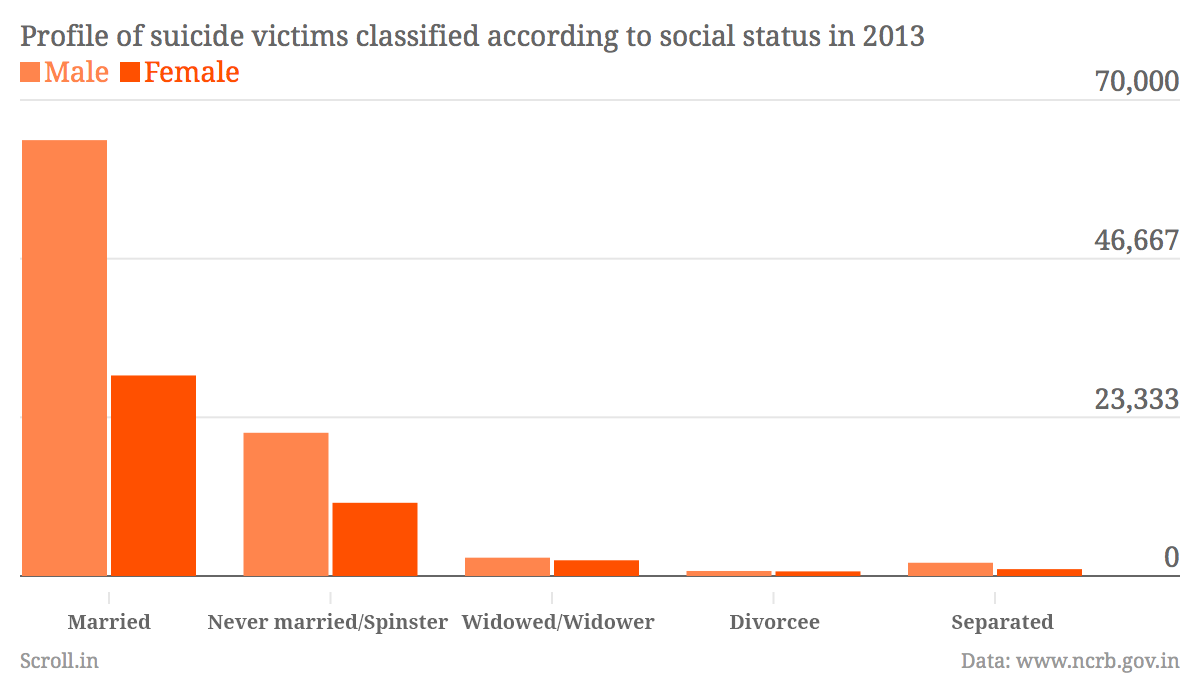
Men commit suicide substantially more than women, whether they are married or not. When categorised by marital status, the largest category of those who commit suicide is married men. That does not necessarily mean that marriage by itself is a cause. Most people are married, hence most of those who commit suicide are married. Even amongst those who have never married, men are more likely to commit suicide.

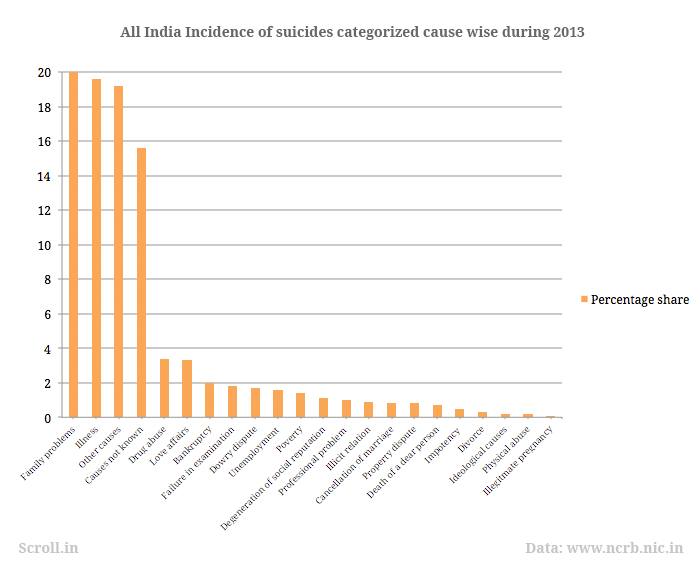
Why do people commit suicide? The biggest reason is “family problems”, though almost equally responsible is illness.

There are more spheres of life where India is seeing turbulence. In small numbers, but a significant rise over the previous year, there has been a sharp rise in suicides due to “illegitimate pregnancies” (up a staggering 64.51% from last year), “fall in social reputation” (up 49.4% from last year) and “professional/career problem” (up 40.81% from last year).

Hanging seems to be the most popular means of committing suicide, followed by poisoning, which was the favourite earlier. This is a trend that is relatively recent. Since 2011, hanging has become the most preferred method and the gap has only been getting wider.


How to Stop Absorbing Other People’s Emotions

http://themindunleashed.org/2014/06/stop-absorbing-peoples-emotions.html


How to Stop Absorbing Other People’s Emotions

Monday, June 30, 2014

Write-up on Aasra in the BBC

Write-up on Aasra in the BBC

4 December 2012Last updated at 14:50 GMT

Shantanu Negi’s Facebook suicide prompts shock in India

By Shalini Joshi Dehradun
 64542907 64542444 Write up on Aasra in the BBC Shantanu Negi’s friends initially believed his Facebook post to be a joke
An Indian student has killed himself after posting a Facebook suicide note.
“Bye everyone… I will miss you… I quit,” wrote Shantanu Negi, 16. Police think he was worried about an exam.
His friends initially believed it to be a joke, with many “liking” his last post and others commenting on it before they found out what happened.
Counsellors working with the social media site to improve reporting and support say many such cases in India are referred but few result in death.
Shantanu’s death occurred at home in the northern town of Dehradun on Monday evening.
Within hours, as the news of the suicide spread, his shocked friends started writing condolence messages.
“Shantanu killed himself because he was worried that he won’t do well in his mathematics examination,” police officer Dinesh Singh Bhandari told the BBC.
A student of class 11 in the prestigious Asian School, Shantanu was a good student who had scored 90% marks in his class 10 examinations.
“Recently, he seemed to have lost interest in studies. We had talked to him about it, but there was no pressure on him,” his father Pushkar Negi said.
From his Facebook profile, Shantanu appeared to be like any other happy and carefree teenager and his school said there had never been any complaints about him.
Helpline Last year, Facebook launched a system to allow users in India and elsewhere to report friends who they think may be contemplating suicide.
In India, the social networking site added the Mumbai-based Aasra suicide prevention helpline – part of the Befrienders Worldwide/Samaritans network – as part of its suicide risk alert system.
Johnson Thomas of Aasra told the BBC that in the past year they had intervened in more than 300 cases forwarded to them by Facebook.
Once a case has been flagged by worried friends, trained counsellors from the helpline email users offering to help them.
“We tell them we are worried and concerned about them. We cannot invade their privacy, but we request them to call us,” Mr Thomas said.
“Very often they do and we talk them out of it. Some just stop posting such messages because they realise they have friends who care for them.”
Mr Thomas says Shantanu “needed reassurance that not performing well in one exam is not a reason to kill himself. We all need people around us to support us.”

More on This Story

Related Stories

  • 07 MARCH 2011, TECHNOLOGY
  •  
  • 7 March 2011Last updated at 16:58 GMT

    Facebook adds Samaritans suicide risk alert system

     51567014 009793180 1 Write up on Aasra in the BBC
    Rory Cellan-Jones shows how the system works
    Facebook is launching a system that allows users to report friends who they think may be contemplating suicide.
    The feature is being run in conjunction with Samaritans, which said several people had used it during a test phase.
    Anyone worried about a friend can fill out a form, detailing their concerns, which is passed to the social networking site’s moderators.
    It follows reports of several cases where Facebook users announced their intention to commit suicide online.
    The reporting page asks for the address (URL) of the Facebook page where the messages are posted, the full name of the user and details of any networks they are members of.
    Suicide-related alerts will be escalated to the highest level, for attention by Facebook’s user operations team.
    Police alert “When a report is made, they then assess whether they need to call the police immediately or forward it on to us,” said Samaritans’ Nicola Peckett.
    Facebook said that it had always been its policy to notify police if a user was at risk of imminent bodily harm.
    The system had been operating in a trial mode, without publicity for three months, during which it received several genuine reports and no hoaxes, according to Samaritans.
    It is hoped that the new reporting mechanism will help prevent cases like that of Simone Back, who died on Christmas day after taking a drug overdose.
    The charity worker from Brighton had written about her intention to kill herself on her Facebook page.
    Several of her friends commented on the message, however no-one raised the alarm.
    Samaritans said that the new system was not launched in relation to one specific case, but to raise awareness of the ways in which people could get help.

  •  
  • 22 SEPTEMBER 2011, SOUTH ASIA
  •  
  •  

  • India police investigate Bangalore ‘Facebook suicide’

     55530827 304272 144213685674025 144211935674200 214402 21190822 n 1 Write up on Aasra in the BBC Malini Murmu was reported to be upset by ‘derogatory’ Facebook comments
    Police in India are looking for the former boyfriend of a student who allegedly committed suicide after he ended their relationship on Facebook.
    Malini Murmu is reported to have hanged herself on Sunday in Bangalore. Her father has demanded that her former boyfriend, Abhishek Dhan, be arrested.
    Police say they are investigating whether the comments on Facebook amount to aiding and abetting suicide.
    The whereabouts of Mr Dhan – also a student – are currently unknown.
    Malini Murmu was a first year MBA student in the Indian Institute of Management (IIM) in Bangalore.
    Ms Murmu’s family say that Mr Dhan’s Facebook account contained derogatory references to her – now deleted – which “forced her to take such a drastic step”.
    In the comments on Sunday he wrote about being “relieved” and “feeling cool” after “dumping his girlfriend”. The pair had reportedly had a row earlier on.
    Ms Murmu’s father told the BBC that her death had left the family devastated.
  • 27 JUNE 2012, INDIA
  •  
  •  
    27 June 2012Last updated at 07:23 GMT

    Why are young Indians killing themselves?

     61189786 017f8cd7 85e7 447a a1dd ec0166725b19 Write up on Aasra in the BBC Suicide has become the second leading cause of death among young Indians
    In the end, wrote Albert Camus, one needs more courage to live than to kill oneself.
    If new research is to be believed, a disturbingly high number of young Indians are losing the courage.
    A study published in the medical journal The Lancet shows that suicide has become the second leading cause of death among the country’s young adults, after road accidents in men, and childbirth-related complications in women.
    There were 187,000 deaths from suicides in India in 2010, the study says – this is higher than the official figure of 134,599 suicide deaths from the National Crime Records Bureau. (Researchers attribute this gap to under-reporting or misreporting as friendly or bribe-seeking coroners often sign off suicide deaths as ones caused by accidents to protect the victim’s family from police harassment and social stigma.)
    If the findings by a team of doctors are to be believed, 40% of the men and 56% of the women who took their lives in 2010 were aged between 15 and 29 years.
    The suicide rate in Indian women aged 15 years or older is more than two and a half times greater than it is in women of the same age in high-income countries, and nearly as high in China. The corresponding rate in men in the same group is between one to two times greater in men of the same age in high-income countries.
    I asked Dr Vikram Patel, a leading Goa-based psychiatrist and professor at the London School Of Hygiene and Tropical Medicine, who co-authored the study, about why he thought this was happening.
    He believes that joblessness for men and post-marriage problems for women trigger off a lot of these suicides. “In women it manifests in depression, in men it becomes a drinking problem,” he says.
    India is a society steeped in the patriarchal tradition, where most women are still expected to stay at home, and bring up children. But more and more women are stepping out to work and aspiring to be independent and successful. But pressures of family, demands for dowry and domestic harassment – and violence – push many such young, married women over the edge in the country’s teeming cities and towns.
    “This is what I call the aspirational reality gap,” says Dr Patel. “Exposure to global media, education doesn’t match up to the realities at home. A touch of anomie worsens matters. Suicide is seen as a potential way out of it.” Perhaps not surprising in a society which lives with one foot in tradition, and the other in modernity.

Article in The Star World(Toronto Star) with reference to AASRA