Cancer Expert Search

Cancer ExpertCancer Expert: Search
Enter your question and submit. Use a complete English sentence for better results.
Cancer Expert, © 2012-2013, ctSearch - Context Search Engine.
Showing posts with label wellness and wellbeing. Show all posts

Monday, July 7, 2014

Married men are most likely to commit suicide in India

http://scroll.in/article/669061/South-India-has-a-higher-suicide-rate-than-the-north

Married men are most likely to commit suicide in India


South India has a higher suicide rate than the north, and other startling findings in the National Crime Record Bureau's 2013 data.


Every day last year, 371 Indians committed suicide, according to data released recently by the National Crime Records Bureau. That is, 1,34,799 Indians, roughly equal to the population of Trinidad and Tobago, killed themselves in 2013. That makes India’s suicide rate 11 for every one lakh persons.

Of the daily figure of 371 suicides, 248 were men; 89 of them ended their lives to escape “family problems”.

Looking at the state-wise distribution of the number of suicides in the map below, it is clear that suicide is more prevalent south of the Vindhyas. Despite having better economic indicators than northern states, Maharashtra, Tamil Nadu and Andhra Pradesh top the list, followed closely by Kerala. By contrast, suicides are the lowest in the poorest states of the Hindi heartland – Uttar Pradesh and Bihar.

A better indicator of where states stand is the rate of suicide per one lakh population. In this, more-accurate metric too, the southern states clearly comes across as unhappier. The least suicide rate, only 1.1, is in the poor state of Bihar.

Here is the full state list:

The highest rate of suicide is not in one of the states seen above, but in the union territory of Puducherry. Puducherry remains the suicide capital despite its rate having come down substantially from 44.8 in 2011 to 35.6 in 2013, still over three times the national average.

Puducherry is followed by Sikkim, the union territory of Andaman and Nicobar islands and then Tripura. Another union territory, Dadra and Nagar Haveli, has a high suicide rate of 21.4, almost double the national average.

Amongst the major cities, the highest rate of suicides, an alarming 65.9, was in Asansol in West Bengal.

The second most suicidal city, Kollam, had a suicide rate of 38.9. India’s top ten cities for suicide are Asansol, Kollam, Rajkot, Chennai, Durg Bhilainagar, Indore, Raipur, Jabalpur, Bengaluru and Kanpur.

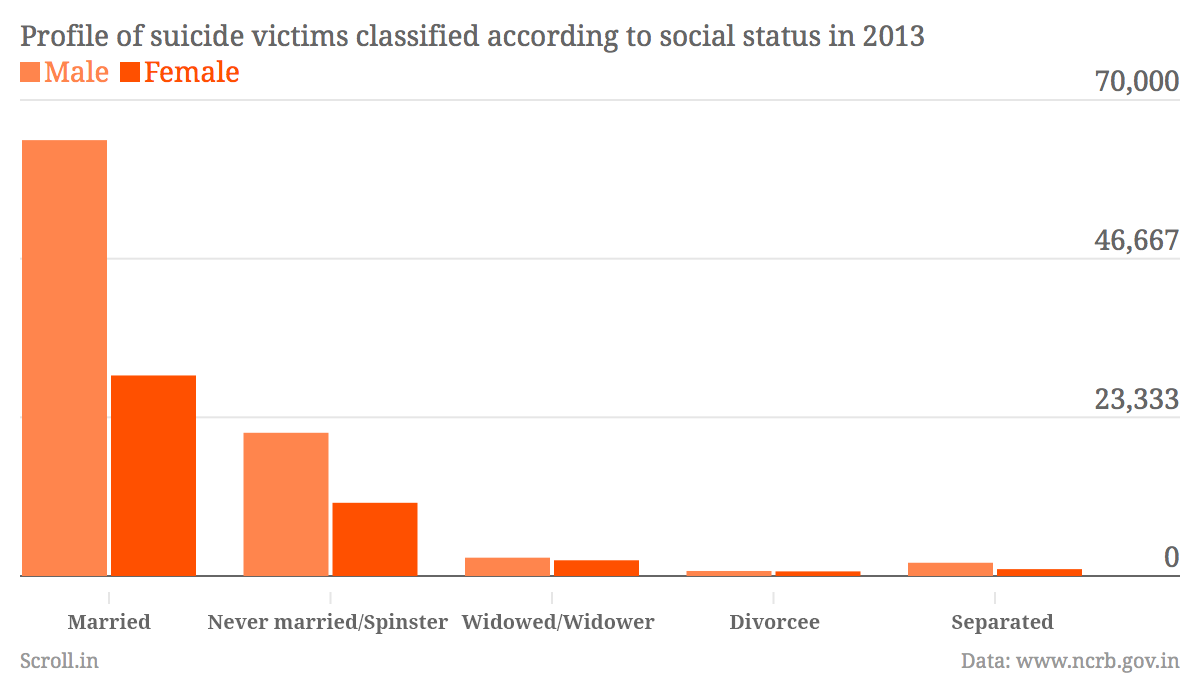
Men commit suicide substantially more than women, whether they are married or not. When categorised by marital status, the largest category of those who commit suicide is married men. That does not necessarily mean that marriage by itself is a cause. Most people are married, hence most of those who commit suicide are married. Even amongst those who have never married, men are more likely to commit suicide.
Why do people commit suicide? The biggest reason is “family problems”, though almost equally responsible is illness.
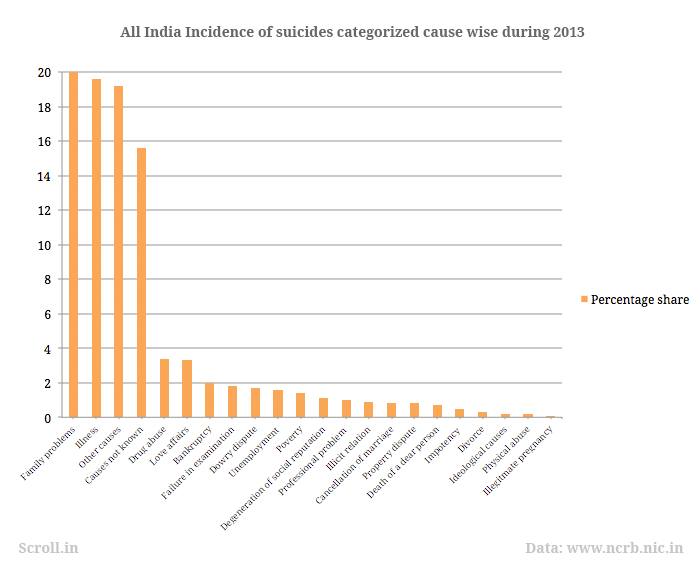
There are more spheres of life where India is seeing turbulence. In small numbers, but a significant rise over the previous year, there has been a sharp rise in suicides due to “illegitimate pregnancies” (up a staggering 64.51% from last year), “fall in social reputation” (up 49.4% from last year) and “professional/career problem” (up 40.81% from last year).

Hanging seems to be the most popular means of committing suicide, followed by poisoning, which was the favourite earlier. This is a trend that is relatively recent. Since 2011, hanging has become the most preferred method and the gap has only been getting wider.


Monday, June 30, 2014

Article in The Star World(Toronto Star) with reference to AASRA

Aasra in Scroll.in on the New mental health Bill 2013

Government's move to decriminalise suicide is half-hearted
The Mental Health Bill says that suicide cannot be prosecuted. But it remains a criminal offence under the Indian Penal Code and allows for people who attempt to take their lives to be incarcerated in institutions.


Amendments to the Mental Health Care Bill were approved by the cabinet on Thursday, in an attempt to protect the rights of people suffering from mental illness. But experts have criticised its provisions relating to suicide, even though the proposed legislation claims to decriminalise the action. Unless the Indian Penal Code is also changed, they say, people who attempt to take their own lives can still be prosecuted.

“At the end of the day, suicide will still be a crime,” said Amba Salelkar, a lawyer and disability and mental health rights activist. “If suicide were truly being decriminalised, legislators would have removed it from the IPC itself.”

The bill will be tabled in the Lok Sabha in the budget session in February. The original draft of the bill was filed in the Rajya Sabha in August 2013. A parliamentary committee on health and family welfare submitted their review of changes to the union cabinet.

At present, attempting to kill oneself is illegal under section 309 of the Indian Penal Code, and can be punished by a year in prison. The Mental Health Care Bill says that notwithstanding the IPC, anyone attempting suicide “shall be presumed...to have severe stress at the time of attempting suicide and shall not be liable to prosecution and punishment."

It goes on to state that it is the government’s responsibility to help ensure that those who have survived a suicide bid do not attempt it again. This clear puts all those who attempt suicide under the health care provisions of the bill, one clause of which includes the right of the government to incarcerate people of unsound mind for up to three months against their will.

By retaining IPC legislation and classifying suicide as a mental illness, the bill effectively gives the government the right to incarcerate anyone in a mental institution if suspected of having attempted suicide, experts say.

“If suicide were truly being decriminalised, legislators would have removed it from the IPC itself,” said Salelkar. “At the end of the day, suicide will still be a crime. This is what makes me uncomfortable about the bill.”

Dr Bhargavi Davar, another mental health activist, added that the decision to cite the cause of suicide as “severe stress” is dangerous because it allows a much larger range of people to be classified as mentally ill. “Mental illness is defined so broadly, any person is liable to be brought under the bill,” she said. “Who in urban areas is not stressed? Will they also be deemed mentally ill?”

She said that the earlier draft of the bill left open the option for people had attempted suicide but did not have any official diagnosis of mental illness to go to court to prevent themselves from being incarcerated in a mental institution. “How do you prove to the court that someone is not stressed?” she asked.

Both Davar and Salelkar believe that the solution would be to change the IPC, and not mention suicide in the Mental Health Care Bill at all.

Not a deterrent

Most psychiatrists agree that criminalising suicide is illogical. According to them, the law has never served as a deterrent to people wanting to take their own lives. The rate of suicides in India has steadily risen in the past five years.


“It is a good move to decriminalise suicide,” said Dr NN Raju, secretary of the Indian Psychiatric Society. “Suicide is a move taken to end suffering. They think it is the only option left to them. Society has an obligation to help them out, rather than labelling them as criminals.”

Dr Kedarnand Banerjee of the National Institute of Behavioural Sciences concurred. “Suicidal people are least bothered about legislation,” he said. “When the thought comes, it comes. Thinking about the law never stopped anyone from attempting suicide.”

While they welcomed the apparent decriminalisation of suicide, they too were not pleased with its being described as a mental illness.

Labelling suicide as a mental illness is inaccurate, according to Raju. “While severe stress doesn’t necessarily cause suicide, calling somebody mentally ill is not correct either,” he said. “Someone who tries to commit suicide may need the help of mental health professionals, certainly, but trying to commit suicide is not necessarily the result of inherent mental instability.”

According to National Crime Records Bureau figures, which are most likely under-representative, India’s rate of suicide, 11.2 per 100,000 in 2012, is far lower than the global rate of 16 per 100,000.

Within India, nuances emerge. More men kill themselves than women. According to an NCRB report, men kill themselves for economic reasons, while women kill themselves for personal reasons. Housewives formed 18.2 per cent of the total number of suicide attempts in 2012. This is more than over half of the women who were reported to have killed themselves in that year.

The top five specified occupations of those who committed suicide from 2001 to 2012 included housewives, farmers, those in private service, the unemployed and self-employed. These constitute 54 per cent of a total of 1.4 million people who killed themselves during this decade.


“It is necessary to understand that suicide is not an event,” said Johnson Thomas, who works with Mumbai-based suicide helpline Aasra. “It is not a one-time process. People go through different stages of stress and when it comes to a head, that is when they commit suicide.” Thomas, however, believes that the bill will be useful as it will force the government to take the responsibility of therapy after a failed suicide attempt, which is their stated intention.

Dangers of the bill

The social and political consequences of including suicide in the Mental Health Care Bill extend beyond just wrongful incarceration if the person survives, according to Salelkar. For instance, if a housewife were to survive a suicide attempt, they will be classified as mentally unstable and could have custody of their children taken away from them under the Juvenile Justice Act.

There are also cases in which pressure from in-laws for dowry is a pressing cause of women committing suicide. “When the case comes to trial, because she is deemed to be mentally ill, her evidence could become shaky,” said Salelkar. “Even if she doesn’t survive, the fact that suicide is filed under the Mental Health Care Act means that the family that might have abetted the suicide has some more room to wiggle out of being convicted.”

Political acts of protest are also likely to be prosecuted as before. Irom Sharmila has been on a hunger strike for ten years now. Each year, she is released from hospital custody for one day, then re-arrested under section 309 of the IPC. The government can choose to argue that Sharmila is not under severe stress. Since suicide has not been decriminalised, the government will not be obliged to release her from custody.

With this misguided attempt to help suicide survivors, experts say, the government has instead laid the ground open for them to be persecuted further.


Becoming What I Might Have Been by Linda Lochridge Hoenigsberg

Becoming What I Might Have Been

Becoming What I Might Have Been
As I passed my 50th birthday, I wondered if I would ever be able to complete some of the dreams I had carried with me for decades. So many things had happened to me. I had been sent to juvenile hall at fourteen, got myself kicked out of school by fifteen, and married by sixteen. We had our firstborn son when I was seventeen, and my husband abandoned my son and me by my eighteenth birthday. Thing went downhill from there. I experienced abuse and trauma. After a gang-rape by six young men I turned to drugs to try to cope with the emotional pain.
By the time I hit my twenties, I was seriously mentally ill. Soon I would lose a brother and three years later, a father, to suicide. I went through another abusive marriage and divorce.
But I worked very hard to recover. These events changed me, but I grew as a person and changed my life. I eventually married a wonderful man. My children grew and became husbands and wives, with families of their own. I had the joy of a house full of grandchildren. My Christmases were no longer the nightmares of drunkenness of my childhood, but instead full of light and peace and the sweet laughter of children.
But now I had fallen down a flight of stairs and broken my neck! It seemed as if life was over.
Then one day I saw a quote by a woman named Mary Ann Evans. She used the pseudonym George Eliot because in her era women authors were not well received. She said, “It’s never too late to become what you might have been.” Since this quote was on an illustration in a magazine, I snipped it out, framed it, and hung it on the wall above my desk. Could I dare to think I still had time to make my dreams reality?
One dream I had since I was in my early twenties was to become a psychotherapist. I wanted to help others as I had been helped. I had attempted some classes at the local community college, but the trials of life kept getting in my way. I eventually gave up. Was it too late? Not according to George Eliot!
I entered college at 51-years-old and began my journey. I worked hard and won a partial scholarship to an award winning four-year liberal arts private college. At 55-years-old, I graduated Maxima cum Laude. I won a much-coveted spot in a masters program at the University of Montana. I was on my way to fulfilling my dream.
Then, in the month I was to begin my new studies, a strange circumstance changed everything. I had torn my rotator cuff and needed surgery. When I woke up in the recovery room, the anesthesiologist leaned over me and said, “Mrs. Hoenigsberg, I need to tell you something. I saw a large mass in your throat. I’ve never seen anything like that in 25 years. You need to have a CT scan right away!” You can imagine the fear that coursed through my body.
Two days later I had the CT scan. There was nothing at all in my throat! But in the very top of the scan, they noticed something disturbing. There, on the very edge of that scan, was a spot. It was a brain tumor.
I was sent to two neurosurgeons in a larger city. Both told me it was inoperable. I had approximately one year to live. This tumor sat close to the brain stem on the underside of my brain and it was growing rapidly.
Something told me that this was not “it” for me. I called a famous neurosurgeon in Los Angeles and asked if he would look at my MRI. He agreed. I’ll never forget the call I got a few days later. “Linda, I can help you.”
The recovery from a very risky six-hour brain surgery was horrendous. I had double vision. I lost the hearing in one ear. I couldn’t walk without help. I had terrible tinnitus and a horrible buzzing in my head that woke me up many times a night. The fatigue was the worst. But if I had learned one thing in my life, it was to never give up.
So I began my master’s studies lying in bed with a patch over one eye and a laptop on a pillow on my lap. For the next three years I studied diligently. By the time I went to my first weeklong residency, I needed a power chair to get around. By the following year I had one reserved for me at the hotel, but I did not have to use it. My tinnitus and the buzzing in my head had disappeared. Then I had enough energy to do my practicum and internships. Soon I had to work a full time job at an agency in order to earn my hours for licensing. It was hard, but I was determined.
Now I am in psychotherapist in private practice. I work with teens and adults and focus on problems similar to those I faced as a young teen and adult. I worked hard to become certified in Dialectical Behavior Therapy, which treats seriously ill people who have suicidal or self-harm behaviors. I did not think I could deal with suicide, since I had been a witness to the suicides of my own family members, but it has only strengthened my resolve to help.
It is my belief that no matter what a person has experienced, no matter how old a person is, they can still become what they might have been. It is never too late.
Photo by anurag agnihotri

Linda Lochridge Hoenigsberg

Linda Lochridge Hoenigsberg is a licensed psychotherapist in private practice. She lives with her husband and their goldendoodle Emma in the Rocky Mountains of Montana. Linda can be reached at www.changeyouremotions.com where she blogs about out of control emotions and emotional health. Soon she will also offer an online DBT Skills Course. Her professional website is at www.lindahoenigsberg.com.

94 Comments

  1. Amazing! You are amazing! Thank you for sharing your story of overcoming so many obstacles and helping others.
    Reply
    • Hi Sherri,
      Thank you so much for commenting. That is so encouraging. Have a very blessed Christmas.

Psychiatric Medications Pharmacology

http://www.healthyplace.com/other-info/psychiatric-medications/psychiatric-medications-pharmacology/

Psychiatric Medications Pharmacology

Bookmark and Share

Font Size

Warning/Disclaimer

Here you'll find detailed information on the usage, dosage, and side-effects of various psychiatric medications such as antidepressants, antipsychotics andantianxiety medications. For the plain English versions, go to the psychiatric medications patient information pages. Extensive information on Psychiatric Medications Treatment.
The information in the "psychiatric medications pharmacology section" of HealthyPlace.com has been selectively abstracted from various sources. The intended use is as an educational aid and does not cover all possible uses, actions, precautions, side effects, or interactions of any of these medications. This information is not intended as medical advice for individual problems or for making an evaluation as to the risks and benefits of taking a particular drug.
The information here should not be used as a substitute for a consultation or visit with your family physician or other health care provider.
We strongly suggest and encourage you to consult with a licensed physician for answers to any questions you may have about these or other medications.
Abilify
Adderall XR
Adapin
Alprazolam
Amantadine
Amitriptyline
Amoxapine
Anafranil
Antabuse
Aricept
Aripiprazole
Artane
Asenapine
Asendin

Ativan
Atomoxetine
Aventyl
BusparBuspirone
Chlordiazepoxide
Chlorpromazine
Cialis
Cibalith-S
Citalopram
Clomipramine
Clonazepam
Clozapine

Clozaril
Concerta
Cymbalta
Dalmane
Depakene
Depakote
Desipramine
Desoxyn
Desvenlafaxine
Desyrel
Dexedrine
Dextroamphetamine
Dextrostat
Diazepam
Dilantin
Disulfiram
Divalproex
Doxepin
Donepezil
Duloxetine
Duralith
Edronax
Effexor XR
Elavil
Endep
Epitol
Eskalith
Escitalopram
Etrafon
Exelon
Exubera
Fetzima
Fluoxetine
FluphenazineFlurazepam
Fluvoxamine
Gabapentin
HalcionHaldolHaloperidol
Imipramine
Imovane
IntunivInvega
Janimine
Klonopin
Latuda
Lamictal
Lamotrigine
Largactil
Levitra
Levomilnacipran
Levoprome
Lexapro
Libritabs

Librium
Lisdexamfetamine
Lithane
Lithium
Lithizine
Lithobid
Lithonate
Lithotabs
Lorazepam
Loxapac
Loxapine
Loxitane
Ludiomil
Luvox
Maprotiline
Mellaril
Memantine
Methamphetamine
Nortriptyline
Nozinan
OlanzapineOrapOxazepame
Paliperidone
Pamelor
Parnate
Paroxetine
Paxil
Permitil
Perphenazine
Pertofrane
Phenelzine
Phenytoin
Pimozide
Piportil
Pipotiazine
Primidone
Pristiq
Prolixin
Protriptyline
Prozac
Quetiapine
ReVia
Rhotrimine
Risperidal
Risperidone
Ritalin
Saphris
Serax
Seroquel
Sertraline
SerzoneSildenafil Citrate
Sinequan
Stelazine
Strattera
Suboxone
Tadalafil
Tegretol

Temazepam
Temposil
Thioridazine
Thiothixene
Thorazine
Tofranil
Topamax
Topiramate
Trazon
Trazodone
Trialodine
Triazolam
Trifluoperazine
Trihexyphenidyl
Trilafon
Trimipramine
Triptil
Valium
ValproateValproic Acid
ValreleaseVardenafil HCI
Venlafaxine
Wellbutrin
Xanax
Zoloft
Zopiclone
ZyprexaZiprasidone

Psychiatric Medication Patient Information Sheets (basics of each medication in plain English)